Sunday, December 22, 2013

Exit stage California: Shasta-Trinity NF, Trinity Alps Wilderness, Klamath NF, Siskiyou Mountains

Maps p, q, and r/a (onward to Oregon)
Shasta-Trinity National Forest from map o continues into map p.
Flora: The forests and woodlands will be filled with gray pine, ponderosa pine, knob cone pine, jeffrey pine, sugar pine, white fir, douglas fir, canyon live oak, huckleberry oak, blue oak, and black oak. Common shrubs will include the whiteleaf manzanita, California buckeye, and California coffee berry, and western redbud. In the canyons we should see willows, big leaf maples, white alder, and dogwood. I am going to make a pdf of pictures and names off common and some uncommon plants we will/may see on the trail. Should be posting that sometime in February after I complete this trail section overview and finish my gear special in January.
After walking around Castle Crags, the trail goes up and follows the Trinity Divide. Follow this link to see a good map of where the trinity divide meets PCT. There are so many things in this area with Trinity in the name; it's a bit ridiculous. The Trinity Divide is known for it's solitude, granite peaks (my fav), glacial lakes, and nice forested land in between.

The trail goes from the Trinity Divide to the Scott Mountains. Here we have another endemic gem! The Scott Mountain phacelia.

The next Trinity along the trail is the Trinity Alps Wilderness apart of the Klamath National Forest. It is known for having 55 alpine lakes. The Scott Mountains are in the northern part of the wilderness.
Farther north in the Klamath Forest are the Siskiyou Mountains which have a population of the endangered Spotted Owls. There are also salmon that live in the Rogue and Klamath watersheds
In general we should have mild temperatures and see the signs of more precipitation in this section.

Rock Climbing: none…at least not marked on mountain project so I will have to keep my eyes open to possible boulders or routes. I'm sure there is something to keep the callouses on my hands :)

Friday, December 20, 2013

Southern Cascade Mountains: Plumas NF, Lassen NF, Lassen Volcano NP, Shasta-Trinity National Forest

maps m and n and o: and the halfway mark!!
After Sierra City the trail enters Plumas National Forest. We will pass the beautiful Gold Lake, cross the Middle Fork Feather River, and head up to Bucks Lake.
We will then head into an area called the crossroads; where granite meets active volcanic region. We will see Mt Lassen, the southern most peak in the Cascade Volcanic Range and the largest plug-dome volcano on the planet. It last erupted in 1915. Lassen National Forest has signs of volcanic action with boiling springs lake (below) and steaming areas.

We go from the pine and fir filled national forest to Lassen Volcanic National Park. Here we will get into some pretty hot territory in the sun and pretty scary territory in a thunderstorm. It's known as Hat Creek Rim. It is a long 27 mile stretch with volcanic rock underfoot and no water in sight. Unfortunately, I have gone 24 hours without a water source before while hiking. It isn't fun, especially in heat and sun, but it is doable. I will probably hike to Old Statioin the morning, eat and resupply there, head to Subway Cave until it cools and then hike until the water cache or beyond depending on how I feel. Some people say this is the hardest section of trail, others seem to pass by it without making a stink. Staying positive and hoping for an overcast but not raining day is all you can hope for. Remember, it's only one or two days of hiking.
Mcarther-Burney Falls State Park ends map n. It is within the Cascade Range and the Modoc Plateau. The Modoc Plateau describes a flat area with pine forests and grasslands with conical mountains. There are wild horses that roam the Modoc Plateau, they probably will not be seen. It is wonderful that wild horses still exist, they are a relic from a time when the planes of North America were filled with herds of wild animals. Mcarther-Burney Falls State Park was designated as such because Samuel Burney bought the land including falls and donated it to the state.
From here the trail heads west into Shasta-Trinity National Forest. This NF is gorgeous and huge and we will see great views of Mt Shasta, but we will also be going south of all the areas that are usually visited. This is both good and bad. I will have to make a trip back down to this area to climb Mt Shasta and rock climb/live around there for a while.
We end map o with Castle Crag.

I will scrambling and climbing about, exploring some route options and then continuing on my way.

Rock Climbing:
Outside of Sierra City there is the bouldering spot Free for All. I will hopefully be moving through these three maps rather quickly. Then I will spend a little time (maybe a long lunch) at Castle Crag. The Cosmic Wall looks like a good route to quickly free climb as long as there is an alright descent.

Monday, December 9, 2013

Central Sierra: Eldorado NF and Tahoe NF

maps k and l

Eldorado National Forest was established in 1910. It had previously been used for harvesting timber and mining. Now that is if forest land the mining has stopped but commercial logging still occurs in some areas. There are islands of private land in a mass in Eldorado, surrounded on all sides by forest lands. This is a forest with many roads new and old, paved and otherwise. Within the National Forest is  Desolation Wilderness. Below is a picture of Horsetail Falls
I can't find any climbing spots on the internet, but this is a gorgeous granite basin; carved by glaciers in ice ages past. The Crystal mountain range can be seen from Aloha Lake. The trail skits the edge of the lake. The photo below gives you a real feel for what we will be walking through.
With bedrock granite and limited soil no fall will be cushy, so good footing and taking a lot of mental breaks will be very important for this section. I hope to run into a porcupine in lower elevations and marmots in higher. Both are comedic animals. Marmots sun bath like they are on a swim suite calendars and look at you like "do I really have to run away from you?"

Tahoe National Forest was established in 1905 but President McKinley had sectioned off a portions of the land in 1899 as forest reserve. It was an attempt to protect the trees from the over logging practices being used at the time. Within Tahoe NF is the Granite Chief Wilderness. The PCT passes right by Granite Chief Peak, the highest in the wilderness ( 9006ft/ 2745m.) It is nothing too special in the summer, but in the winter there is a popular ski traverse from Granite Chief Peak to Needle Peak. Despite the name, this area actually has quite a lot of greenery.

I couldn't find any endangered flora, but if anyone knows of some I would be happy to learn of them.

Rock Climbing:
Echo Lake is not just home of a resort, but also home to some pretty wicked climbing. This is another PCT score because all the approaches start from the PCT. The trad routes are right close. I pretty much have to try my hand at Path of Life: AKA Thug Life; it's an easy 5.8 trad route on Gangsta Wall and it's a perfect route to climb free. If I meet up with people with gear, I'll hopefully jump on some of the 5.10s and try my hand at an 5.11 while I'm there (AKA fail, 5.11 is still passed my pay grade, maybe in 2015). Flagpole Wall and New Peculiar is close too.
Next bit of climbing is at Donner Pass. For those looking for a classic 5.11d, check out Manic Depression on Snowshed Wall. Donner Pass also bring some more moderate climbing, it looks a like another trail jackpot. I'm looking forward to Baboon Crag; apparently the PCT walks right up to this odd shaped wall. Just look at The Gecko (5.10c).

Sunday, December 1, 2013

Central Sierra: Yosemite NP, Humboldt-Toiyabe NF, Stanislaus NF

Halfmile maps i and j

This is where we start to come down from the high's of the Sierra's and into the land of the granite domes. Going to Yosemite has always been a dream of mine and being able to walk through it's Wilderness will make the experience even richer. From Tuolumne Meadows we trek from tourist mecca, across some beautiful granite outcrops and into the area less traveled. We pass by Mt Matterhorn in the Sawtooth range and thus passing what is considered to be the start/end of the High Sierra's.
Yosemite Wilderness ranges from the Lower Montane Forest of Yosemite Valley to the Upper Montane Forest and the Subalpine Forest. Maybe when near water you will be visited by a endangered Yosemite Toad.
From Yosemite National Park and Wilderness area we head into Humboldt-Toiyabe National Forest; the largest National Forest in the lower 48 covering 6.3 million acres mostly in Nevada and a bit over in California. Although large, it is not contiguous. The forest lies in 13 counties in NV and 6 in CA. We just pass through a patch before we head into the Stanislaus National Forest.
Stanislaus National Forest got national attention this past year. It was where the Rim Fire began in August of 2013. It grew to be the third largest wildfire in CA recorded history. We will no doubt see the damage from last years event. If you read the Forest Service Website, Stanislaus National Forest sounds dreamy. "You can swim near a sandy beach or wade into cold clear streams cooling your feet" now that sounds lovely. After many miles of hiking, I could probably use a good swim. Even though the website doesn't show any weakness in it's nature-perfect facade, I'm sure the dreaminess/insane beauty of this forest is also partnered with a great sadness. Fire may be necessary for life, but it still hurts my heart to see the impact of a large burn.

Carson-Iceberg Wilderness is partial in the two national forests above. The Silver King Creek within it's borders supports the only native population of Paiute Cutthroat trout in existence. I'm going to use this amazing fact to iterate how important it is as backpackers to respect water. Soap residue is become a huge threat in remote areas. Unfortunately the safest option for taking a shower with soap in the backcountry is also a pain in the butt; collect water needed for shower, walk 200ft, shower and poor grey water out (double check location to make sure no water sources are around). That seems hard for me to actually commit to on a trail. So I like using two options: 1) the easy and cheap option, don't use soap expect for hands and dishes (I am happy to cart a half liter of water 200ft)  2) if I really can't take it I can wet a pack towel and take a quick towel bath with soap 200ft from water source. Just please don't take a bath directly in the stream/lake with soap. I have made this mistake before because my soap didn't have any chemicals in it, but really adding anything to the environments we will be traversing would be detrimental to the small, local animal and plant populations.

The Mokelumne Wilderness is where granite and lava beautifully collide. This is Piero's view headed up Round Top. In most of the pictures I've hunted down, the wild flowers in this section look unreal.


Flora:
With this section a new tree is added to you usual suspects. Along with Lodgepole pines, jeffery pines, aspen, and juniper comes mountain mahogany.
Endangered to this area is the Slender Stemmed Monkey Flower
Mariposa Desert Parsley
Yosemite Woolly Sunflower
Phantom Orchid


Fauna:
Record where and when you see a California Condor, Sierra Nevada Bighorn Sheep, and cutthroat trout as these animals have been having a hard go of it.

Rock Climbing:
Map i starts and ends with good climbing areas, but nothing is really marked in the middle. It starts with Tuolumne Meadows, which were covered in last blog entry, and ends with Sonora Pass. There is bouldering, route climbs (mostly sport) off Highway 108, and another area named Saint Mary's boulders. Then we jump to map j which starts with Sonora Pass and ends with Echo Lake. Same deal as with map i; good climbing at ends, nothing in the middle. Luther Rocks is a bit east from the trail off of the highway. Echo Lake rock climbing will be covered in the next blog with map k.

Friday, November 22, 2013

Southern Sierra: Pacific Crest Trail, John Muir Trail, or High Sierra Route

Halfmile maps g and h
I could write a novel on these sections alone. There is not enough attention span to read all of the information I want to write on section g and h. But I need to speed up this research process so I will just hit the highlights.

First up, South Sierra Wilderness which is managed by Sequoia National Forest and Inyo National Forest. It includes Kennedy Meadows, check out the website video, it's goofy and cute.
We move from the South Sierra Wilderness to Inyo National Forest which is the home to Mount Whitney, you know, the highest mountain in the contiguous United States. I am way too pumped to climb it. Of course this is a side trip from the PCT, if you stay overnight or decide to walk east of Mount Whitney to Lone Pine you need a permit. As you can imagine, it's probably going to be quite busy. There is no way I am not climbing Whitney. It's only 250ft (76m) taller than my last 14er and I will have 767mi (1235km) of training.
Map H is the first big trail decisions, but not the last. Do you follow the John Muir Trail and the PCT to the right after Kearsarge Pinnacles or do you take the High Sierra Alternate route? Along the High Sierra route is Charlotte Dome, the Palisade Basin, Goethe Cirque, Mt Ritter and much more. It rarely goes below 10,000ft (3048m) and it take a lot more navigation skills (Beta). Along the JMT and PCT you see Mt Clarence King, Mt Pinchot, Mt Darwin, Evolution Lakes and much more. They intersect and cross each other several times. Once at Kearsage Pass, Sixty Lake Basin, Le Conte Ranger Station/ Bishop Pass Trail, Evolution Lake, Tully Hole, Devil's Postpile National Monument, Tuolumne Meadows. At Devil's PostPile, you can also choose whether to follow the John Muir Trail rather than the PCT or the High Sierra Route. After Tuolumne Meadows the High Sierra Route goes north to Twin Lakes and the PCT continues West and the John Muir Trail continues to Yosemite Valley/Curry Village. I will study each route and probably end up with a combination route of my own depending on what I would like to experience. Some of these decision I will leave up to future, on-the-trail me. If I feel like taking the JMT to Half Dome then I will, for now, I'm just trying to give myself to information I need to make smart decisions.
Sixty Lake Basin; photo from Leor Pantilat's Adventures


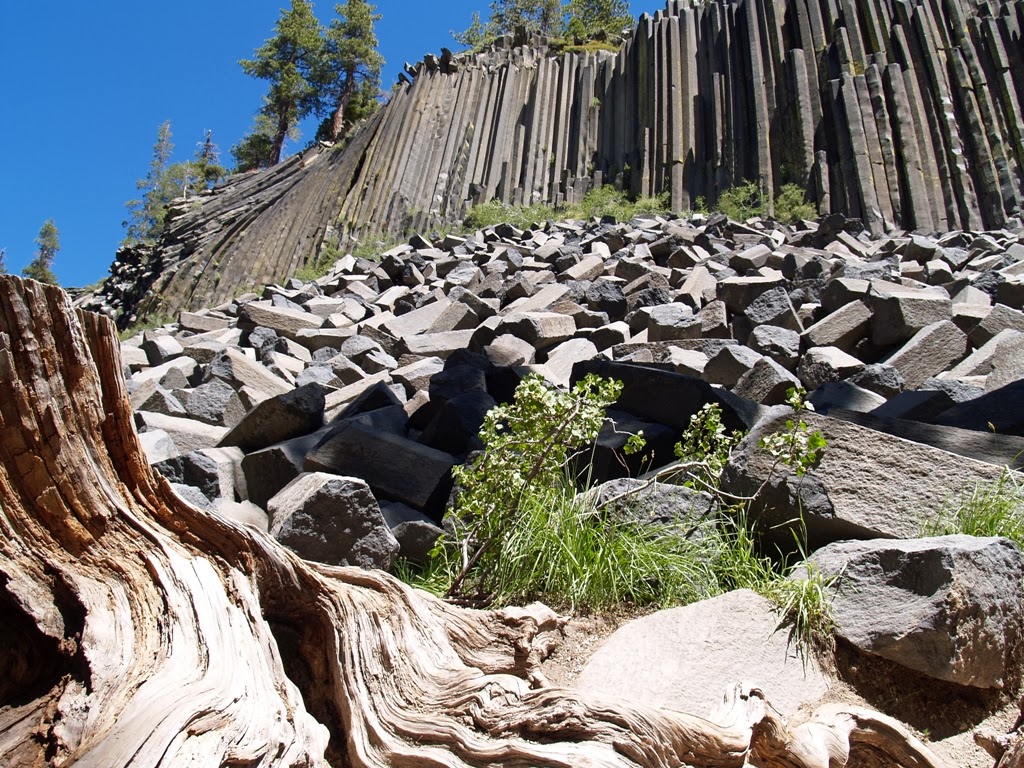
Devil's Postpile National Monument made of columnar basalt; photo from Open air and Sunshine


Flora:
There are two radically different environments to be experienced depending on elevation. Below 11,000ft (3350m) there will be lodge pole pines, jeffery pines, red firs, bristlecone pines (Inyo National Forest protects the Ancient Bristlecone Pine Forest with the oldest known living bristlecone pine on earth), and low woody shrubs, but as we climb higher the plants get closer and closer to the ground and we will begin to see alpine flowers and shrubs.
Take note and report these rare native gems: gunsight clarkia
goosefoot yellow violet
ceanothus pinetorum or kern ceanothus


Fauna:
Look out for Monache Mule Deer, Sierra Nevada Red Fox, Pine Martens, Mountain Lions, and black bears. According to some trail notes from On the Trail, there are aggressive bears between Little Pete Meadow and Big Pete Meadow camping grounds.

Rock Climbing:
There is a rock climbing spot on the other side of Owens Peak named Indian Wells Canyon. From the trail you head east to the Owen Ridge line. There looks to be climbing to be found all along the ridge back but not a lot of people frequent it because of the difficult approaches and pockets of rotted granite. There are some long routes but not hard routes. I will have to watch my hand placement, but this seems like a great place to have some adventure time.
There is a place we will be somewhat close to but still too far away to really call it "off the trail." It's the Needles/Kern River area and it's basically the Big Rock Candy Mountain of climbing in the Southern Sierra's. Routes are everywhere and you get the see the Kern River Valley which is gorgeous AND there are bouldering routes over deep water…sounds like heaven. I may have to come back and visit this one. I don't think I will have enough time to get over there, enjoy it, and get back to the trail. It's the sort of place where I would want to have a kayak, mountain bike, and climbing gear and live there for a week or two.
The Horseshoe Lake area provides numerous sport climbs, bouldering around June Lakes, bouldering in Tuolumne MeadowsLembert Dome, and alpine climbs where ever you look.

Thursday, November 14, 2013

Southern Sierra: Kiavah Wilderness and Sequoia National Park

Halfmile maps f

From Cameron Canyon Rd aka Hwy 58 aka Tehachapi Pass the trail treks up by LaRose Falls and waterfall canyon. I'm curious if the beauty matches the name and might take a trail detour to check out the area. From the looks of the map, it seems like water in the Piute Mountain Range will not be an issue on the first part of this section. As we traverse around cache peak there area is littered with springs on either side of the trail but beware hikers get sick on this section so be careful, take some extra Vitamin C, and make sure your water is clean. After this short spurt of water it goes dry so carry a lot.

From the satellite view it looks like the trail comes down into dry lands before it hikes up into the Scodie Mountain section of the Kiavah Wilderness and Sequoia National Park, south east of Lake Isabella. In the screen capture below Lake Isabella is in the top left of the screen. The PCT traverses from the Piute Mtn range on the left side of the screen, directly below Mayan Peak (point A), and then north to the green range on the top right side (the Scodie Mtns.)

Maybe there is some shade to be found around the Pinyon Mtns. Even if there isn't that much shade to be found, there may be another treat. Pine Nuts from the Pinyon Pine. For those who can eat them, they are a tasty treat.

Flora:
It looks like another hot and sunny section. Even Scodie Mtn, which is supposed to be a reprieve from the sun looks rather arid.

But don't let it fool you, the plants we get to experience here are very special. The Kiavah Wilderness is one of the two places that can support Pinyon-Juniper woodlands in CA. One can also find Mormon teaburro bush, Joshua Trees, grey pines, and a variety of wildflowers which are blooming April to June. The rare gem on this section of trail is the Walker Pass milkvetch, a endemic legume. It has only been recorded as seen three times. If you see it, please take notes and report it/ don't bother it. I will be hunting a few west facing hillsides for this little survivor.


Friday, November 8, 2013

Back to Desert: Angeles National Forest and Mojave Desert

Halfmile Project maps d and e

Angeles National Forest is the first national forest in California, historical landmark #717. Within the it rise the San Gabriel Mountains. They separate the Los Angeles Basin and the Mojave Desert and act as a water collection system for the surrounding areas. Mount "Baldy" (or Mount San Antonio) is the highest peak in Los Angeles County measuring 10, 068ft (3,069m). image from wikipedia on San Antonio. 


The National Forest has seen it's share of mishaps. You may or may not remember that in July of last year three campgrounds were closed in Angeles National Forest due to the discovery of a bubonic plague outbreak among squirrels. A fire scorched over 161,000 acres of land, that's 1/4th of the forest in August of 2009 which almost took out the Mount Wilson Observatory and the antenna farm which, among other things, broadcasts the police and fire department emergency channels. That would have sucked. The area is still in the recovery period.
Other fun facts: -Black bears are not native to this region, but in 1933 eleven rambunctious bears from Yosemite Valley were transferred here. -Baldy Camp was the hip nightlife of LA during prohibition.
The trail follows along side several sections of road, seem like map d and e are good places to have gear trouble or to strike up some conversations with day hikers or find some people with ropes to share for climbing. The trail dips down from the mountains at Aqua Dulce and then it heads back up where we tool around past Green Valley and continue to mountain roam.


Mojave Desert:

The trail descends from the mountains into Neenach, CA. From the town we will traverse through Antelope Valley, which is the western tip of the Mojave Desert. Then the trail ascends into arid mountain and canyon lands, passing through wind farms, until it exits into Cameron Canyon.
Antelope Valley was named after the abundant pronghorn sheep population, but after drought, too much snow, over hunting, etc the numbers now are few. I still hope to see one.


Flora: After spending quite a while in ponderosa, lodgepole, and jeffrey pines we will descend back into chaparral and then into sage brush and desert. The difference being we will have some new plants in the mix this time since Antelope Valley gets more rain and ground water than most. There is the California poppy (all the pictures of this massive bloom are beautiful but we will most likely miss it), the infamous Joshua Tree, the California Juniper, and many more plants that like this area.


Rock Climbing: Tunnel Crag is first to pass. It is barely out of the way and as long as there is somewhere to walk along Hwy 2. I will probably skip this one unless I meet someone with rope because it's 5.10 and 5.11 routes only. Past my free climbing comfort grades. Next up, a little more of a detour, Williamson Rock. Pretty much just sport, 5.6 -5.13. It looks real beautiful.


I'm most excited about Horse Flats. It just looks fun to mess around in with lots of bouldering and some trad climbs. Maybe a good place to take a climbing 0 day?